Skeleton Money Holder Card: 3D SVG Shapes Review
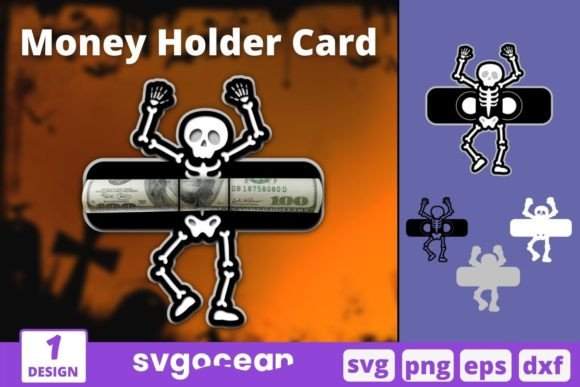
When evaluating a new graphic design asset for a client project, my first question is always about versatility and technical integrity. Recently, while developing a seasonal campaign for an alternative lifestyle boutique and an accompanying Etsy product line, I tested the Skeleton Money Holder Card Svg. The project required a visual hook that balanced macabre aesthetics with functional utility, specifically for a "cash stuffing" or budgeting niche audience. My initial impression of this asset was positive; it successfully bridges the gap between novelty illustration and usable commercial design. Unlike flat, generic clipart, this file presents itself as a structured 3D SVG composition. The depth implied in the shapes gives it a tangible quality that is essential for product mockups and marketing visuals where the viewer needs to understand the object's physical form instantly.
Evaluating Visual Mood for Alternative Brand Identity
The Skeleton Money Holder Card Svg carries a distinct personality that immediately signals its ideal use case. It is playful yet edgy, making it perfect for brands targeting Gen Z, goth aesthetics, or Halloween-centric promotions. In my test project, the asset served as the anchor for a brand identity refresh. The skeletal motif acts as more than just decoration; it communicates a specific subcultural alignment. For small business branding, this level of specificity is valuable. It saves time on custom illustration while providing a polished look that feels bespoke. However, designers must recognize that this mood is dominant. It dictates the tone of the entire layout. When integrating this into a creative design workflow, I found it paired exceptionally well with distressed textures and bold, condensed typography, reinforcing the gritty, handmade business vibe my client requested.
Performance Across Print-on-Demand and Digital Channels
A true test of any design bundle is how it translates across different mediums. For this review, I deployed the Skeleton Money Holder Card Svg in three distinct scenarios: t-shirt design, social media graphics, and packaging design. In apparel, specifically for direct-to-garment printing, the vector paths were clean enough to scale without jagged edges, which is critical for maintaining professional quality on dark fabrics. As a sublimation design, the included PNG format offered vibrant color retention, though I recommend verifying the DPI for larger prints.
On the digital front, the asset performed strongly in Instagram carousel posts and Pinterest pins. The inherent 3D styling of the shapes creates natural negative space, allowing for easy text overlay without obscuring the main graphic. This is a significant advantage for content creators and marketers who need to produce high-volume social content quickly. For web design and blog visuals, the SVG format ensured crisp rendering on retina displays, maintaining visual hierarchy even when resized responsively. The asset also proved useful for Canva template creation, where non-designers can easily manipulate the elements without breaking the composition.
Strategic Placement in Complex Layouts
Understanding where to place this asset is as important as the asset itself. Based on my testing, the Skeleton Money Holder Card Svg excels in large layout areas and hero graphics. It has enough visual weight to stand alone as a focal point on a flyer, poster, or website header. It is particularly effective in product mockups, where the 3D nature of the illustration helps potential customers visualize the actual money holder product. For editorial design and magazine spreads, it works beautifully as a drop cap alternative or a section divider that maintains thematic consistency.
Conversely, there are environments where this asset requires caution. Due to the intricate details typical of skeletal illustrations and 3D shading, it struggles at very small sizes. Using it as a tiny icon in a navigation bar or a footer element resulted in visual mud; the lines bled together, destroying readability. It also clashes with minimalist corporate branding or luxury aesthetics that rely on ample whitespace and subtle geometry. If your client’s project demands a sterile, high-end corporate look, this graphic will likely undermine the desired professionalism. Furthermore, on complex, busy backgrounds, the asset can get lost unless you apply a stroke or drop shadow to separate it from the noise.
Technical Inspection and File Format Utility
Professional designers know that a pretty preview image does not guarantee a usable file. This svg bundle comes in a single ZIP file with the following file formats: SVG, PNG, EPS, DXF, and DWG. This comprehensive inclusion is a major selling point for commercial design work. During my technical audit, I prioritized the SVG and EPS files for their editability. I was able to ungroup elements, adjust colors to match the client’s specific Pantone palette, and modify line weights without degradation. This vector flexibility is non-negotiable for logo design integration or custom merchandise variations.
The DXF and DWG formats are specifically relevant for Cricut users and those working with laser cutters or CNC machines. I tested the DXF in cutting software, and the paths were optimized, meaning fewer weld points and smoother cuts for physical money holders or sticker design. The PNG file included high-resolution transparency, which passed my check for clean edges—no white halos or pixelation artifacts. Always inspect PNG transparency before using it for print-on-demand products, as bad masking can ruin a batch of mugs or tote bags. For those using this in architectural or industrial design contexts, the DWG format provides a rare crossover utility that most standard clipart lacks.
Designer Checklist for Commercial Application
Before clearing this asset for a real client project, run through this practical checklist to ensure it meets professional standards:
- Contrast Testing: Preview the Skeleton Money Holder Card Svg on both pure white and pure black backgrounds. Ensure the internal details of the skeleton remain visible in both modes.
- Typography Pairing: Test the asset against serif, sans-serif, script, and display fonts. In my experience, it pairs best with bold sans-serifs or grunge display fonts; delicate scripts often compete with the linework.
- Scalability Stress Test: Scale the vector down to 1 inch and up to 24 inches. Verify that the 3D shading holds up at large sizes and that lines do not disappear at small sizes.
- Mockup Validation: Never approve a design based on the flat file alone. Place it on a realistic product mockup to see how the lighting and texture interact with the illustration.
- Licensing Confirmation: Always verify the commercial license terms. Just because a digital product is available on a creative marketplace does not automatically grant unlimited resale rights for modified templates or mass-produced goods.
- Color Mode Check: If the source file is RGB, convert to CMYK before sending to print. Skeletal whites and bone tones can shift significantly during conversion, so manual color correction may be necessary.
Final Verdict for Creative Professionals
The Skeleton Money Holder Card Svg is a robust tool for the right context. It offers genuine value for designers working in alternative niches, seasonal marketing, and maker communities. Its strength lies in its hybrid nature—functioning as both a decorative illustration and a structural shape that implies volume. For brand owners and digital sellers, it reduces the cost of custom 3D rendering while delivering a premium aesthetic. However, it is not a universal solution. Success depends on respecting its visual weight and technical limitations. When used with intention and proper technical preparation, this asset elevates projects from amateur to professional, providing the visual trust and engagement necessary for successful commercial campaigns. Whether you are building a Cricut project library or designing a full-scale packaging suite, this bundle warrants a spot in your curated asset collection, provided you apply it with strategic design judgment.